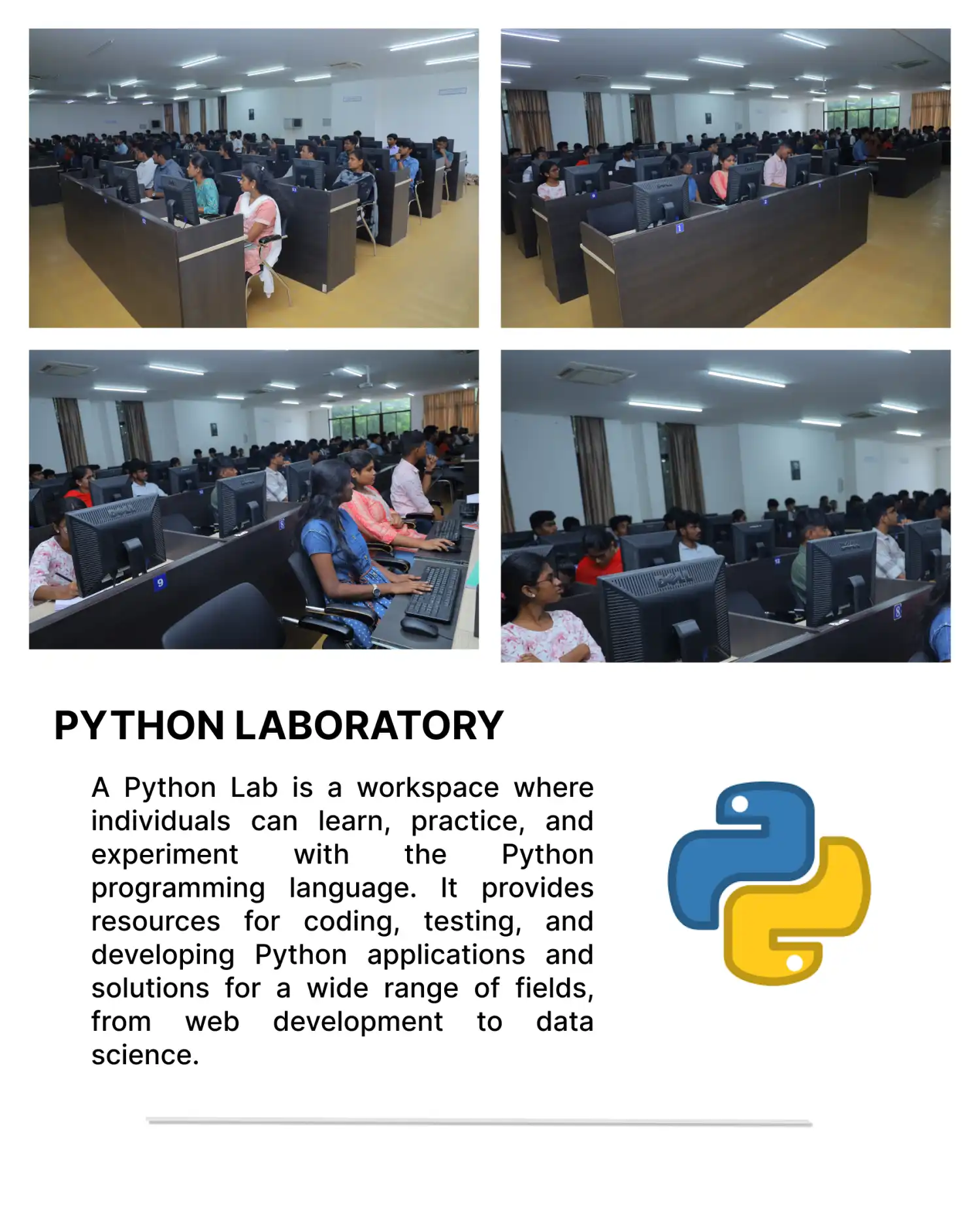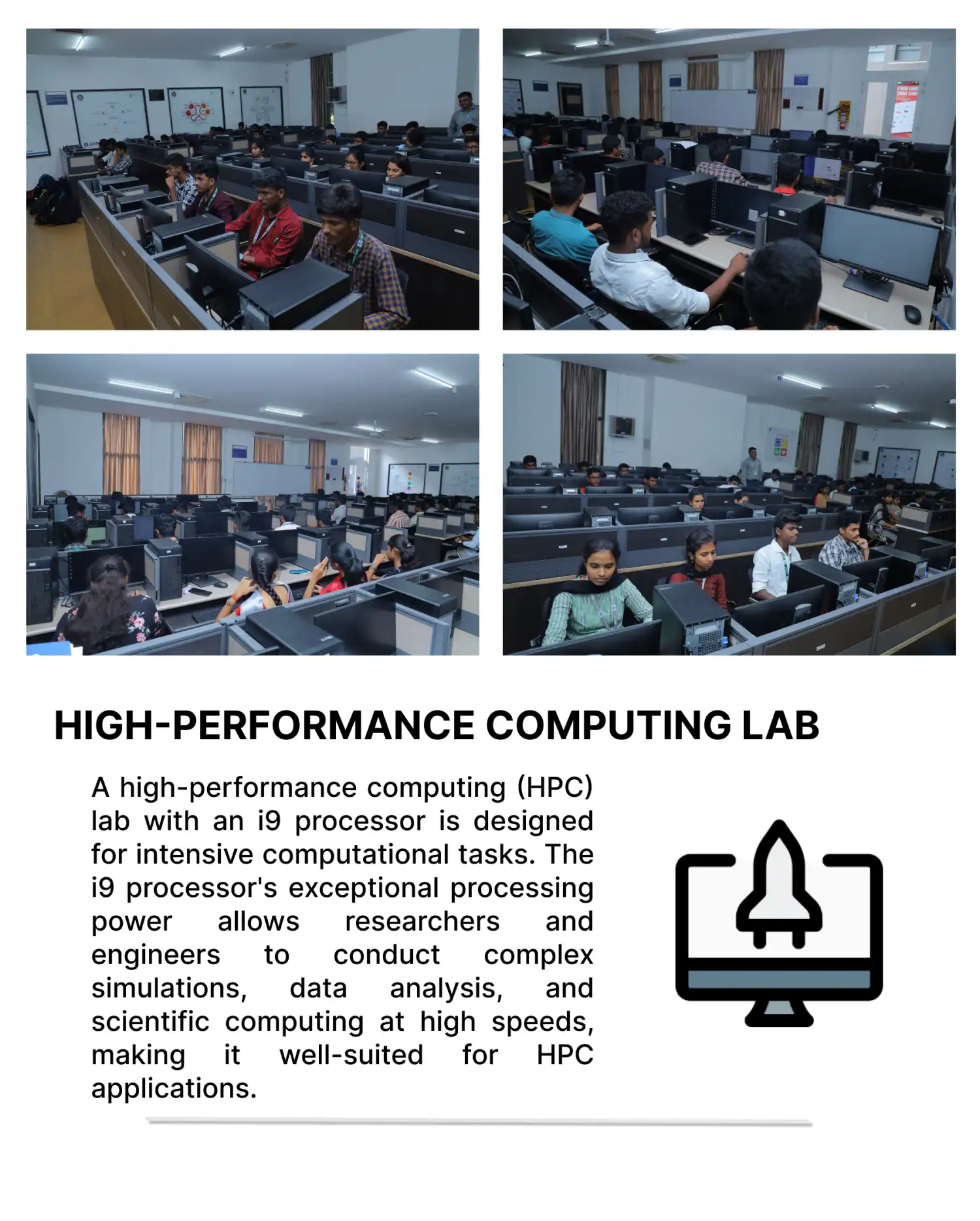

With every business and organization going digital, the IT sector today is a booming field as compared to other sectors and there is a huge demand of Computer Science Engineers and programmers.

The Computer Science and Engineering (CSE) department began in 2010 with 60 students in its undergraduate program. By that same year, we expanded to accommodate 240 students. In 2014, we introduced a Master's program in CSE, starting with 18 students. Our department is also a recognized research center under Anna University, supporting over 50 research scholars in various fields. Currently, we serve over 900 students across undergraduate, postgraduate, and Ph.D. programs.
In just ten years, our department has achieved many milestones. We now have 50 faculty members, each an expert in different areas of computer science. Half of them have Ph.D. degrees, and many others are working towards them. We're proud that three faculty members have completed postdoctoral fellowships at international universities. Our faculty contribute through publications in journals, research articles, and conference presentations.

To be a premier centre for education, dissemination of knowledge and research in the frontier areas of computer science and engineering to serve the community with moral values.
PEO 1: Acquire knowledge and skills on cutting edge technologies in the field of computer science and engineering.
PEO 2: Inculcate a passion for continuous learning through further studies and research in the field of computer science and engineering.
PEO 3: Develop innovative ideas upholding the rich value systems to solve the changing technological needs.
PO 1. Engineering knowledge: Apply knowledge of mathematics, natural science, computing, engineering fundamentals and an engineering specialization as specified in WK1 to WK4 respectively to develop to the solution of complex engineering problems.
PO 2. Problem analysis: Identify, formulate, review research literature and analyze complex engineering problems reaching substantiated conclusions with consideration for sustainable development. (WK1 to WK4)
PO 3. Design/Development of Solutions: Design creative solutions for complex engineering problems and design/develop systems/components/processes to meet identified needs with consideration for the public health and safety, whole-life cost, net zero carbon, culture, society and environment as required. (WK5)
PO 4. Conduct Investigations of Complex Problems: Conduct investigations of complex engineering problems using research-based knowledge including design of experiments, modelling, analysis & interpretation of data to provide valid conclusions. (WK8)
PO 5. Engineering tool usage: Create, select and apply appropriate techniques, resources and modern engineering & IT tools, including prediction and modelling recognizing their limitations to solve complex engineering problems. (WK2 and WK6)
PO 6. The engineer and the world: Analyze and evaluate societal and environmental aspects while solving complex engineering problems for its impact on sustainability with reference to economy, health, safety, legal framework, culture and environment. (WK1, WK5, and WK7).
PO 7. Ethics: Apply ethical principles and commit to professional ethics, human values, diversity and inclusion; adhere to national & international laws. (WK9)
PO 8. Individual and collaborative team work: Function effectively as an individual, and as a member or leader in diverse/multi-disciplinary teams.
PO 9. Communication: Communicate effectively and inclusively within the engineering community and society at large, such as being able to comprehend and write effective reports and design documentation, make effective presentations considering cultural, language, and learning differences
PO 10. Project management and finance: Apply knowledge and understanding of engineering management principles and economic decision-making and apply these to one’s own work, as a member and leader in a team, and to manage projects and in multidisciplinary environments
PO 11. Life-Long learning: Recognize the need for, and have the preparation and ability for i) independent and life-long learning ii) adaptability to new and emerging technologies and iii) critical thinking in the broadest context of technological change. (WK8)
PSO 1: Solve complex engineering problems by building integrated systems across various domains of Computational Intelligence.
PSO 2: Apply technical skills to produce solutions that meet the requirements of the emerging technologies in Computer Science and Engineering.
Duration: 4 years (Regular) / 3 Years (Lateral Entry)
No. of Semesters: 8 (Regular) / 6 (Lateral Entry)
Intake / No. of Seats: 240


Associate Tech Lead / CS
Associate Tech Lead / CS
Associate Tech Lead / CS

Associate Tech Lead / CS
Associate Tech Lead / CS
Senior Assistant / CS
Junior Assistant / CS
Training Co-ordinator / CS

| S. No. | Faculty Name | Subject Name | Topic Name | Link |
|---|---|---|---|---|
| 1 | Dr Vishnu Kumar K | Computer Organization and Architecture | Data path and control -- ALU and Register file connection | |
| Computer Organization and Architecture | Data Path and control -- Fetching and sorting | |||
| 2 | Dr Mouthami K | Pattern Recognition | ML-3D Transformation | |
| Deep Neural Networks | Introduction to DNN | |||
| Deep Neural Networks | DL Color models | |||
| 3 | Dr Kandaswamy S | Algorithms and Data Structures | Linear data structures list | |
| Algorithms and Data Structures | Sequential search algorithm analysis | |||
| Algorithms and Data Structures | Problem solving techniques Design | |||
| 4 | Dr Primya T | Java Programming | History of Java | |
| Java Programming | Pillar of OOP | |||
| Object Oriented Software Engineering | Object Oriented Software Engineering - Introduction | |||
| 5 | Mr Premkumar D | VAC - Machine Learning Fundamentals for Real-time Applications | Introduction to Artificial Neural Network | |
| 6 | Mr Mohan M | Python Programming | Numpy | |
| Python Programming | Pandas | |||
| Python Programming | Data Structures | |||
| 7 | Mr Rajesh Kumar S | Web Technologies | Servlet Implementation - Part 1 | |
| Web Technologies | Servlet Implementation | |||
| Web Technologies Lab | PHP Database Connectivity | |||
| 8 | Ms Sasikala C | Theory of Computation | Push Down Automata | |
| Theory of Computation | Chomsky Normal Form | |||
| Theory of Computation | NFA into DFA Conversion | |||
| 9 | Ms Jeevitha R | Operating Systems | Memory Management | |
| Blockchain Technology | Introduction to Blockchain | |||
| Computer Organization and Architecture | Addressing Modes Problems | |||
| 10 | Ms Vishnupriya B | Compiler Design | Optimization Techniques | |
| Compiler Design | Issues in Runtime Storage Management | |||
| Compiler Design | DAG Representation | |||
| Python Programming | Python Modules and Packages | |||
| 11 | Dr Priya V | Python Programming | Numpy and Pandas | |
| Problem Solving and C Programming | Searching - C Programming | |||
| 12 | Ms Geetha S K | Computer Networks | CN - TCP | |
| Computer Networks | CN - DNS | |||
| Cloud Computing | Load Balancing | |||
| Blockchain Technology | Hashing |
| S. No. | Faculty Name | Course Developed | Link |
|---|---|---|---|
| 1 | Dr. Vishnu Kumar K | Introduction to Linux and Linux Utilities | Link |
| 2 | Dr. Manjula Devi R | Selection Sorting | Link |
| 3 | Dr. Nisha Soms | Conversion of Regular Expression to Epsilon NFA | Link |
| 4 | Dr. Mouthami K | Introduction to Deep Neural Networks | Link |
| 5 | Dr. Priya V | Polynomial Addition using Linked List, Searching and Sorting Algorithms | Link |
| 6 | Dr. Primya T | C - Pointers | Link |
| 7 | Dr. Kandasamy S | Sequential Search Algorithms, Problem Solving Design Techniques | Link |
| 8 | Mr. Thivaharan S | Web Technology: Client and Server Side Scripting | Link |
| 9 | Mr. Rajesh Kumar S | Web Technologies | Link |
| 10 | Mr. Naveen Kumar M | Design and Analysis of Algorithms | Link |
| 11 | Ms. Nandhini N | Android Data Storage | Link |
| 12 | Mr. Premkumar D | Spare Tire Problem in ML | Link |
| 13 | Mr. Mohan M | Python: Numpy and Pandas | Link |
| 14 | Ms. Jeevitha R | Data Structures | Link |
| 15 | Ms. Kiruthika J K | Introduction to AI | Link |
| 16 | Mr. Rajesh Kumar S | The Overview of Java | Link |

Download the strategy document to understand what are the opportunities available for a student at KPRIET










KPRIET – An AI Integrated Campus
Preparing future-ready engineers with AI-integrated teaching and learning. KPRIET integrates Artificial Intelligence across teaching, learning, research and innovation to create a smarter, future-ready campus experience for students and faculty.